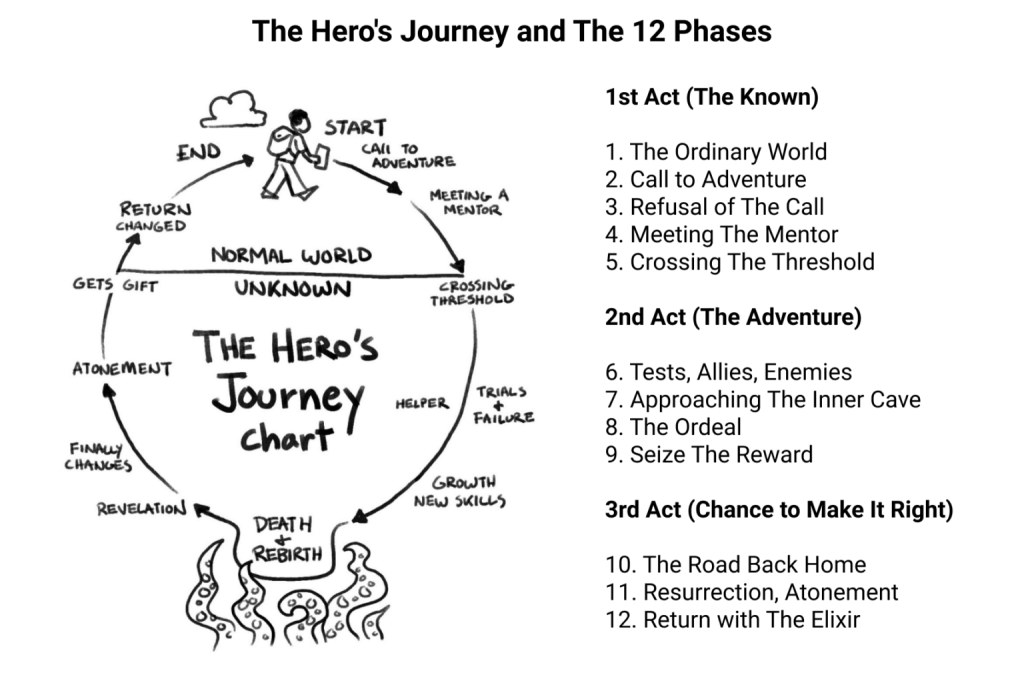
At the most fundamental level of narrative creation we can examine the structure of storytelling utilising the Hero’s Journey proposed by Joseph Campbell in “The Hero With A Thousand Faces”.Campbell advocates the majority of stories can effectively be condensed down into a formula regardless of culture as “a universal motif of adventure and transformation that runs through virtually all of the worlds mythic traditions” (Campell, 2008).
The artwork of book covers can tell a story within themselves. If we use the Harry Potter franchise as an example we can see distinctive changes in the protagonist across the seven volumes as he ages and the stories become more fraught with peril and escalating stakes.
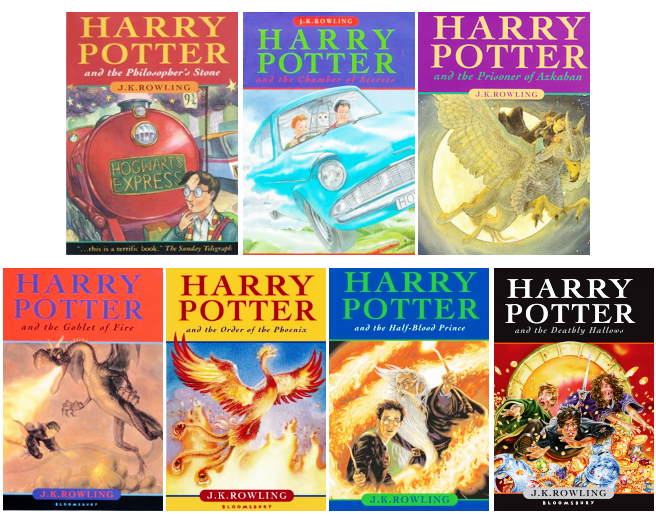
Campbell advocates that “Our strategy for understanding these narrative graphics is to hold constant the underlying information and then to watch how various designs and designers cope with common data”(Tufte, 1994).
It is possible to observe cadence and pacing in a narrative purely by examining the waveform data of an audiobook. In the example below we can see that VoiceOverAngela utilises short gaps in her cadence as the recording she is working on is a guided meditation session. This visually demonstrates the pacing of the piece is slow, and an effort was made to ensure that the audience can process each step at the correct pace.
In the second example from Bethany Stall we can see the script for a children’s book she is working on and in this section she is using different inflection points for the characters voices. This allows the waveform to rise and fall in a less controlled manner than the previous example which utilised a much more steady tone when delivered. It is still possible to see the gaps in the recording which can be used to denote when the pacing is hastened or slowed. This could also be used to visualise where a chapter break is on an isolated vocal layer.
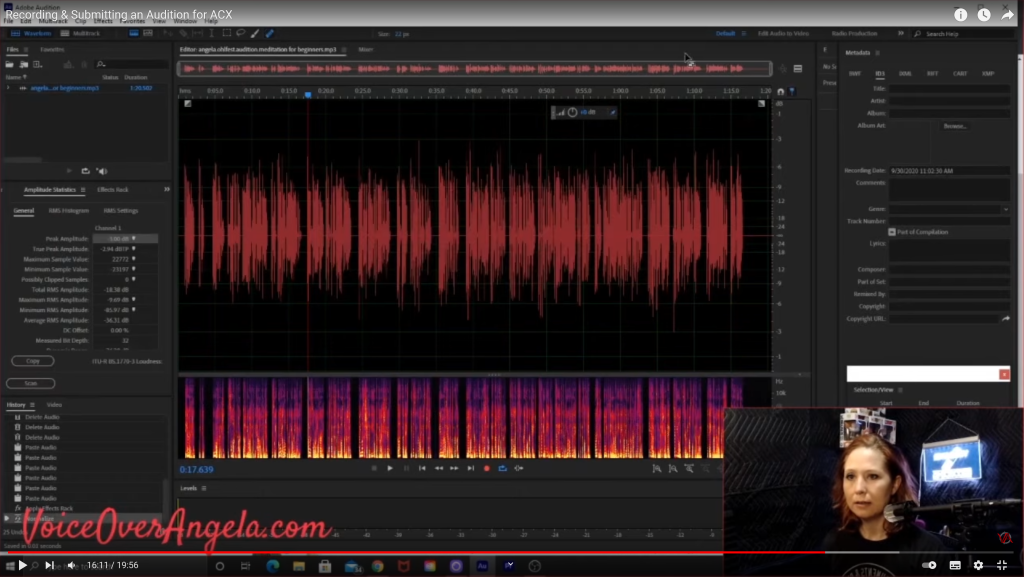
VoiceOverAngela has breaks in recording with little fluctuation (VoiceOverAngela, 2020) 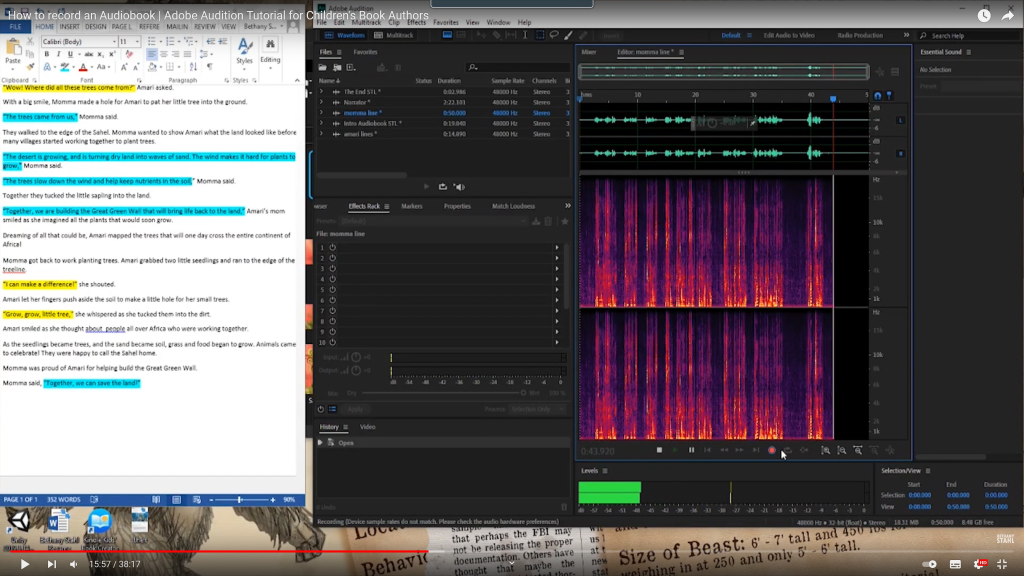
The waveform is more vibrant due to the cadence in this recording (Stahl, 2020)
Bibliography
Campbell, J. (2008). The hero with a thousand faces (3rd ed.). New World Library; Joseph Campbell Foundation.
Kanbanize, n.d. The Hero Of Thousand Faces Circle. [image] Available at: <https://kanbanize.com/blog/heros-journey-evolutionary-change-management/> [Accessed 29 October 2021].
Pottertalk.net, (2013). A brief history of Harry Potter book covers. [image] Available at: <http://www.pottertalk.net/2013/08/retrospective-of-harry-potter-book.html> [Accessed 31 October 2021].
Stahl, B., (2020). How to record an Audiobook | Adobe Audition Tutorial for Children’s Book Authors. Available at: <https://www.youtube.com/watch?v=nikxh8eT-D0&t=1123s> [Accessed 31 October 2021].
VoiceOverAngela, (2020). Recording & Submitting an Audition for ACX. Available at: <https://www.youtube.com/watch?v=46vfN_shSPs> [Accessed 31 October 2021].